
The Interborough Fleet, 1900-1939 (Composites, Hi-V, Low-V)

Roster
Other ways to view the above table: Excel Download | (PDF)
Description
Prototypes and Composite Cars
Around 1902, in the advent of IRT Subway operation, newer cars were developed out of necessity to provide protection for riders against the perilous confines of subway tunnels, and better accommodate hurried throngs of people. Initially two cars were developed as prototypes (the August Belmont and the John B. McDonald), being constructed of wood with some steel in the underframe, and resembling trailers built for the Northwestern Elevated of Chicago in 1898.
These had been the first American rapid transit cars produced with enclosed vestibules, and were equipped with hand-operated folding doors (much like those on a telephone booth). The final production model for the IRT Subway was a modified version of this basic design, with heavyweight steel framing and a copper and wood-sheathed body finish, to provide more strength and better protection against collisions than the elevated cars had. The new Subway cars were also about five feet longer than standard el cars due to more generous clearances on the Subway Division, and were also slightly convex outward at the window ledge, eliminating the somewhat cramped interior appearance of the elevated cars. By the end of 1902, the new subway car design had been completed, and 500 units were ordered from several builders. Delivered in 1903 and 1904, these "Composite" cars were tested on some parts of the Manhattan Elevated system prior to completion of the subway.
While modern in design for 1902, the Composite cars were nevertheless a controversial entity on the IRT after beginning subway service mixed with steel "Gibbs" cars in October, 1904. They were said to present a great fire hazards, which it was feared would lead to catastrophe in the confines of the Interborough's underground lines, and would present a such greater potential for lose in the event of a collision, especially with a steel car. In spite of this stigma they rolled on, and were given center doors in 1910 to aid in passenger flow, which by this time had far outstripped anything the IRT Subway lines had been designed to absorb. In addition, 78 Motor cars were converted to Trailers about this time, so as to help accommodate the operation of longer trains. Their final disposition from the Subway Division came about in 1915 with the purchase of new steel car bodies which were to be placed on the Composite cars' trucks. In turn, new lighter weight trucks were to be built for the Composite cars, permitting them to be used in Elevated Division service. In addition to being removed from the subway, the Composites would also help to solve the IRT's problem of providing enough cars for the expanded services soon to begin in the wake of system-wide Dual Contracts improvements.
On January 17, 1916 the first trains of Composite cars were in service on the 3 Ave. Local-Express route, and also on the 2 Ave.-Freeman St. Express, where they operated over some shared Subway Division trackage. Because of their added weight even with the lighter trucks, the Composites had to run lite in the return direction of their rush hour trips so as not to overtax the structures. The entire Composite car fleet had been transferred to the Manhattan Elevated lines by December, 1916.
High-Voltage (Hi-V)
The idea of using all-steel rapid transit equipment was not a new one as the IRT prepared for Subway Division operation, however it was not a highly developed one either. Such cars had been thought of as the future of rapid transit design since the 1890's, when they became popular in the railroad industry, but no way had been researched as to how to utilize this technology on a smaller scale. In addition, there was no great need for steel cars before the IRT Subway appeared, as all previous lines (except for a short stretch in Boston) were operated exclusively over elevated or grade-level rights-of-way. Thus, there was an unwillingness by anyone except the IRT to expend the necessary capital to develop the steel car, and the builders themselves were perfectly satisfied to continue turning out wood or wood-steel cars if that was what the market demanded.
In 1902, it was the rapidly progressing construction of the IRT which forced management to pursue equipment development that was geared toward the mass-production of cars safely constructed for prolonged underground travel. The issue of an all-steel car was forced by public concerns over the danger of using wood, or even wood-steel, cars in such a surrounding. In an attempt to face up to the challenge of providing steel cars, the IRT retained George Gibbs, a Pennsylvania Railroad mechanical engineer, in what amounted to an experimental capacity to bring the all-steel rapid transit car to reality.
In 1903, a prototype car which essentially consisted of Composite-like steel framing and riveted steel plates, took shape at the PRR's Altoona Shops. The car arrived in New York late in the year, was tested and slightly modified. Apparently satisfied with the final product, the IRT placed two orders with American Car & Foundry for 300 similar cars. In fact, the Long Island Railroad later ordered several identical cars of its own for an anticipated through service from the Flatbush Ave. Terminal to Grand Central via the IRT. As far as can be determined, the "Gibbs" Hi-V cars weighed in the vicinity of 75,000 lbs., as opposed to the standard el cars with an approximate weight of 60,000 lbs. The added weight had been foreseen as a likelihood while the new IRT Subway Division structures on Broadway and Westchester Ave. were being built, and they were thus reinforced to handle the additional tonnage. The first of the steel cars arrived from ACF in the Summer of 1904, and several were on hand for the October 27 opening. The remainder arrived through the first part of 1905, the Gibbs Car fleet being joined eventually by the Altoona prototype, car 3342.
As the original IRT Subway Division lines expanded with the coming of the Contract II routes between 1905 and 1908, 50 more cars were added to the fleet, these being the unique "Deck Roof" Hi-V Motors (3650-3699), in order to provide sufficient equipment to run more trains. By 1910, IRT Subway traffic flow had become so heavy that it was necessary to operate longer trains, and rearrange the existing fleet to improve passenger flow. Thus, 325 more Standard Hi-V Motor cars were delivered in the 1910-11 period, to increase the fleet size from 850 to 1,175. These newer cars, as delivered, were equipped with manual end doors, as the Composite, Gibbs and Deck Roof cars had been, but also had pneumatically-powered center doors controlled by the conductor from the end of the car. In 1910-1912, the older cars (Composite, Gibbs and Deck Roof) were likewise retro-fitted with pneumatic center doors, and because of this had to be shored-up structurally through the use of a "fish-belly" at the center of the sill. They also had the transverse seating at the cars' interior center replaced by an extension of the longitudinal pattern used in the rest of the interior.
In early 1914, with the approach of the IRT's Dual Contracts expansion, the IRT was intending to purchase 500 additional steel cars of the type they had used since 1904. This plan, however, was disrupted by continued displeasure on the parts of both the riding public and the Public Service Commission over the continued use of wood-steel equipment underground. The final result was the IRT being forced to commit itself to the outright replacement of the Composites in the subway with steel cars. In the long-run, this political trade-off may have been primarily responsible for the IRT's coming up short on equipment to operate its new lines in The Bronx and Brooklyn between 1917 and 1920, which forced the use of connecting shuttles. At any rate, the proposed 500-car order of 1914 was drastically altered after this, eventually being broken up into several different parts. In early 1915, a total of 490 cars were ordered from Pullman for the IRT, of which 292 were Hi-V Trailers (4223-4514), compatible for operation with the Composite, Gibbs, Deck Roof and Standard Hi-V Motors then running. It was the arrival of these Trailers in the Fall of 1915 that permitted the Composites to begin leaving the Subway Division for the Manhattan Elevated. By 1916, all of the Hi-V Trailers were in operation, and the original fleet (now nick-named "Hi-V's", to delineate them from the new Lo-V cars being delivered) soon began to change. The Hi-V's, somewhat arbitrarily, gained a reputation as being slower than the new Lo-V cars, and unable to keep up with the ever-more rigorous pace being established in IRT operation. As such, they were relegated, for the most part, to local services after the "H" system went into effect on August 1, 1918.
Multiple-Unit Door Control was installed in 127 Hi-V Trailers and 266 Hi-V Motors in 1923-24, creating a separate fleet from the older manual/pneumatic-door cars, and thus enabling trains requiring smaller crews to be run, especially off-peak. In 1934, as the IRT was feeling the pinch of forced competition with the BMT and IND, economization led to the integration of manual/pneumatic and MUDC Hi-V cars in "combination" consists, so they could be spread about the system where Hi-V's were used, and reduce the number of conductors required on all lines at all times. This effort apparently did not solve the problem entirely, for in 1936 the IRT installed MUDC in 288 more Hi-V's (125 Motors and 163 Trailers), and they were again segregated into separate trains. As of 1937, the following Hi-V fleet breakdown existed:
- Hi-V MUDC Motors: 3514, 3517, 3519, 3525-3566, 3568-3590, 3592-3637, 3639-3649 (Gibbs); 3757-3814, 3816-3914, 3916-4024 (Standard Hi-V's)
- Hi-V MUDC Trailers: 4223-4266, 4268-4366, 4368-4514
- Manual/Pneumatic Motors: 3342?, 3350-3513, 3515, 3516, 3518, 3520-3524, 3567, 3591, 3638 (Gibbs); 3650-3699 (Deck Roof); 3700-3756, 3815, 3915 (Standard Hi-V)
In 1952, 20 Hi-V Trailer cars were converted to non-control "Blind" motors (4223-4242), in an attempt to speed the Hi-V's up on the Broadway and Lenox locals, as the task of pulling Trailers began to tell on the aging Hi-V Motors (some of which were approaching the age of 50). Eight more Trailers (4243-4250) were converted to Blind Motors in 1955. Actual replacement of the Hi-V's, both Manual/Pneumatic and MUDC, began after the R-17's entered service on the #6 Lexington-Pelham Local in October, 1955. By November, 1956 all Gibbs and Standard Hi-V Motors, as well as Trailers, assigned to the Lexington-Pelham route had been removed from service and scrapped or transferred, so that all Hi-V cars remaining on the IRT were assigned to the 7th Ave.-Broadway and 7th Ave.-Lenox routes. New R-21 and R-22 cars began service on the #1-Broadway Express route in November, 1956 and had completely supplanted Hi-V's there by the Spring of 1957. By early 1958, Hi-V cars (still with representatives of all types) were in use during peak periods on the Broadway and Lenox Local routes, and at times on the 7th Ave.-Bronx Express. These remaining cars were then gradually withdrawn from service as the final R-22 cars were delivered for service on the #1-Broadway Express and #2-Bronx Express routes. As best as can be determined, the last Hi-V's were operated in early to mid-September, 1958.
Low-Voltage (Low-V)
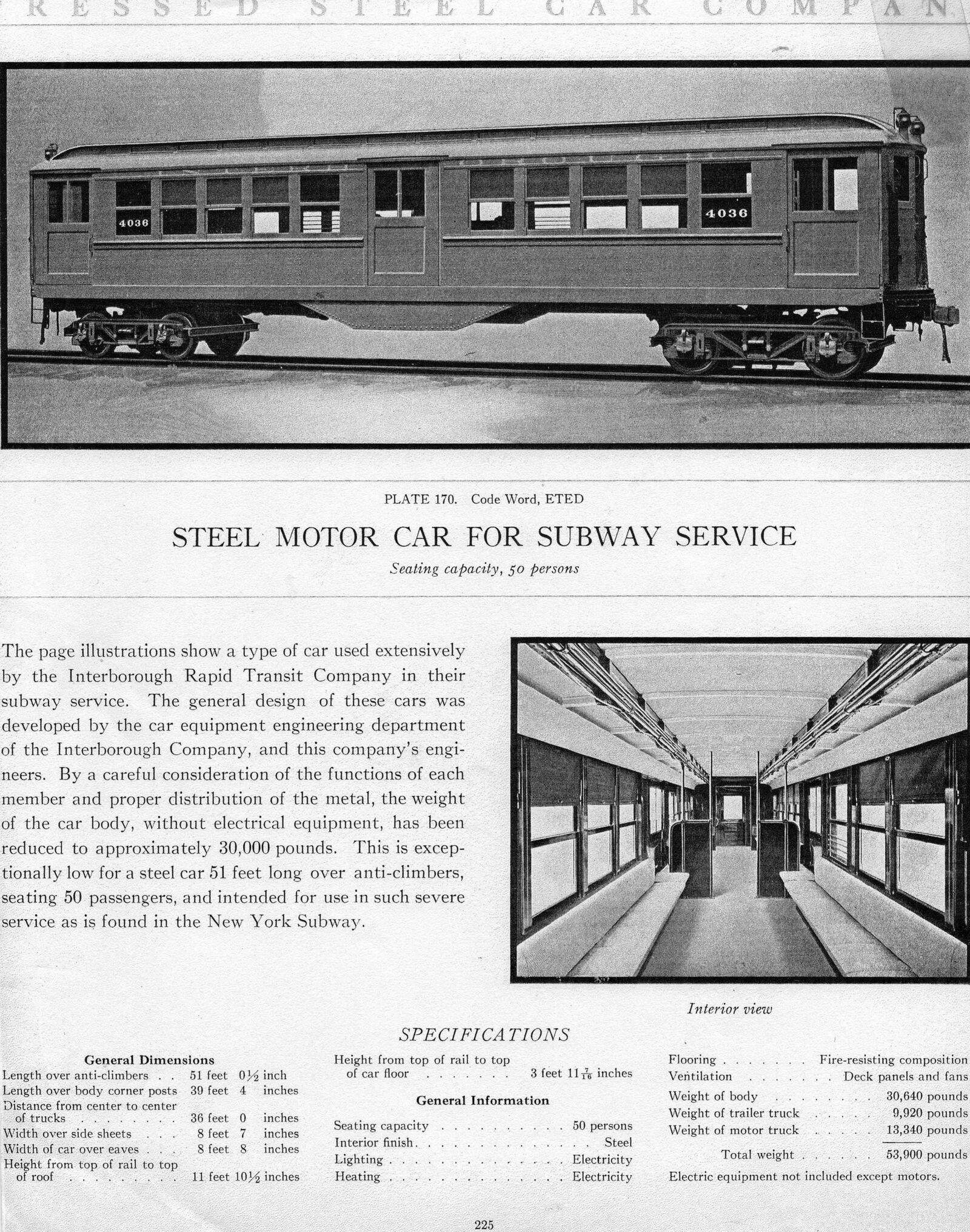 Low-V Pressed Steel Builder Fact Sheet |
 Low-V Pullman Front View |
 Low-V Pullman Side View | |
In order to understand the exact nature of the "Lo-V" it is necessary to look at a series of wood-steel motor cars delivered to the distant Metropolitan West Side Elevated of Chicago in 1904. These cars (numbered 2790-2927 after the 1913 Unification) featured a new type of control, manufactured by Westinghouse, which did not rely on the 600 volts DC produced by the third rail to operate, but rather used a lower voltage relayed from a series of batteries, which in turn were fed directly from the third rail source. The advantages of this new set-up were numerous, including the simplification of control wiring and a reduction in employee hazard, because all trainlines (which in those days had to be hand-connected during train make-up in the yards) and control casings were no longer directly in touch with a lethal 600 volt source. In succeeding years, this low-voltage control was continuously viewed as somewhat experimental in spite of its obvious success, and was not installed in any more production orders (though further development by both Westinghouse and GE continued) until in 1914 most of the Chicago Elevated Railway's new 4000-series Motor cars were built with a capability of using either a high- or low-voltage power supply. Rapid transit car orders placed in intervening years had been exclusively high-voltage, including cars for such new operations as the Market St. Subway-Elevated in Philadelphia and the Hudson & Manhattan system of New York and New Jersey. In Boston, all elevated equipment, and even the newer Cambridge Subway cars delivered were built with high-voltage control right through 1928, in order to maintain a standardized fleet using a proven design. The IRT continued the use of high-voltage control in its Manhattan Elevated cars, also for compatibility, until some cars were modified to low-voltage when rebuilt as MUDC's in 1923-24. Originally, it intended to also continue using high-voltage control in its expanding Subway Division fleet, but this was, over time, changed.
In 1914, as the IRT was preparing its equipment needs for the impending Dual Contracts expansion, it completed various design engineering studies, evaluating its own equipment and how best it might be improved, technology used elsewhere which might be taken advantage of, and the expected demands of service the new fleet would face. The end result was the conversion of the proposed 500-car order into several different orders, and this gave the IRT the opportunity to use low-voltage control on its smaller component of the order intended for service to Queens, where they would not be mixed in Main Line operation. When these first "Steinway" cars (4025-4036) were ordered early in 1915, their specification not only called for low-voltage control, but in addition required that they be fitted with trucks having a special lower gear ratio to overcome the steep grade in the Steinway Tunnels. The cars arrived on the IRT in the Spring of 1915 and were on hand when the Steinway Tunnel route was opened that June 22.
The carbody configuration of the Steinways, and all subsequent Lo-V's ordered through 1925, was basically the same as the modified version of the Hi-V (post-1910) with three side door openings (two vestibule, one center), and longitudinal seating for the length of the car. As originally constructed the first several orders of Lo-V cars were not equipped with MUDC, being converted by the arrival of cars 5303-5502 in 1924.
Use of the low-voltage control system appears to have had a high value to IRT management, because it reduced the company's liability due to accident, and involved less maintenance cost in the long run. It was the former consideration which led to a hybrid order for 124 motor cars (4037-4160) and 62 trailers (4161-4222), which had the same high-voltage control as was used previously, but low-voltage trainlines hooked into a battery power supply. Thus, yard personnel were exposed to a great deal less danger during train make-up moves. To cut the cost of this part of the order even further, the control system was integrated with the same motors used previously, enabling these cars to be built as bodies and fitted on Composite trucks after their arrival in New York. This category of cars became the "Flivver" class, with all entering service between November, 1915 and mid-1916.
By late 1915, it was apparent that the low-voltage control system used on the Steinway cars was successful, and the IRT committed itself to the use of this type in all future equipment orders, in spite of the fact that it created two totally separate and incompatible fleets. 62 "Standard" Lo-V trailers (4515-4576) and 164 motor cars (4577-4699 and 4771-4810) were ordered from Pullman in early 1916, along with 71 additional Steinway motor cars (4700-4770). All of the Lo-V's from the first 1916 order entered IRT Main Line or Queens service by early 1917. On the Main Lines (Broadway, Bronx and Lenox), the new Lo-V's were used to supplement the older cars, then shifted to the new Dual Contracts lines as they opened in 1917 and 1918. Late in 1916, 155 additional Lo-V trailers (4811-4965) and 337 motors (4966-5302) were ordered. All further acquisitions to service the IRT's rapidly expanding Subway Division were then curtailed due to ensuing Wartime restrictions. This left the IRT with a total of 903 Lo-V cars on the Main Lines (including Flivvers), along with 676 older Hi-V cars, available to provide service on the eight lines (including the 42 St. and Bowling Green Shuttles) created by the August 1, 1918 service changes. The Steinway Tunnel routes to Corona and Astoria were equipped with 83 "Steinway" Lo-V Motors. Obviously, this was enough to provide adequate service on the Manhattan core routes, but woefully insufficient to keep up with overall system growth.
In spite of the fact that the IRT could have begun acquiring more cars in 1919 after the removal of World War I restrictions, its shaky financial condition in the immediate postwar years inhibited its ability to do so. However, this did not prevent the company from imposing certain cost-cutting measures with the fleet it had. Between 1920 and 1922, Multiple-Unit Door Control was developed and applied to each Lo-V, being then applied to some el cars and Hi-V's a year later. In 1923, conditions improved sufficiently, and the IRT ordered 200 badly-needed care including 100 Standard Lo-V trailers (5303-5402) and 100 Standard Lo-V motors (5403-5502), these being the first to have built-in MUDC. The arrival of these units later in 1923 and early in 1924 led to an increase in through services, and a reduction in the use of the more costly non-MUDC Hi-V cars. The final group of cars the IRT acquired for its Dual Contracts expansion, ultimately resolving almost all of its equipment shortages, was ordered in 1924 from ACF. This originally consisted of 150 Standard Lo-V Motors (5503-5652), but the last 25 cars were changed to Steinway Motors by their 1925 delivery (5628-5652). These new cars rounded out the IRT Dual Contracts subway fleet at just over 2,000 cars, enough to provide full service, but with few units to spare.
By the time the Queens lines were extended from Grand Central to Times Square in the mid-1920's, and the Corona line pushed to its permanent terminal at Main St.-Flushing in 1928, ridership had grown astronomically, and the 108-car fleet on these routes had to be supplemented by a few trains of Standard-Lo-Vs. The IRT attempted to solve this problem by the conversion of eight Flivver Trailers (4215-4222) and 22 Standard Lo-V Trailers (4555-4576) to Steinway Motor cars in 1929. Following the onset of the Great Depression, the IRT could no longer deal effectively with its equipment shortage problems, but at the same time the riding crunch subsided, and the problem became less critical. The only subsequent change of consequence occurred in 1942, when Lo-V Steinway car 4719 was trapped at Lenox Shops as the 2 Ave-Queensboro Bridge line was removed from service. The car was converted to a Standard Lo-V Motor as a result, and car 4771, a Standard Lo-V Motor, was converted to a Steinway in exchange.
In 1937, the Interborough set to work on a new design for cars to serve the Flushing line, in order to provide extra equipment for the upcoming 1939 World's Fair at Flushing Meadow. A relatively small number of cars were to be ordered, as the IRT was strapped for cash. A design evolved which permitted compatibility with earlier Steinway Lo-V's, yet presented a more contemporary appearance, with a body style derived from designs used previously on the BMT Standards and on the IND R-1/9's. Three evenly-spaced doors were used on each side, dividing each car roughly into three equal sections. They also featured a new-style roof contour that let fresh air in but kept rain water out, and a full roller curtain signbox assembly, so that each train's destination was clearly marked. St. Louis Car Co. was contracted to produce 50 of these units (5653-5702), and they were placed in service on the Flushing line upon their arrival in November, 1938. The World's Fair Steinways subsequently inaugurated Flushing/World's Fair Express service in April, 1939, and remained a fleet separate from the Steinway Lo-V's inasmuch as possible, until they left the Flushing line in 1949.
The first major reassignment of the Lo-V's career occurred when 350 new R-12, R-14 and R-15 SMEE-type cars were acquired for Flushing service, replacing the Steinway fleet, which still had to be supplemented by a few Standard Lo-V's borrowed from the Main Lines. By Spring, 1949 all borrowed cars were returned to the Main Lines, all World's Fair cars were transferred to the Lexington-Pelham Local route, and a few of the Steinway Lo-V's had found a new home on the Broadway Local and Express, and the Polo Grounds Shuttle. The Steinways were gradually replaced by the R-14's and R-15's as they entered service on the #7-Flushing line, the last cars joining their sister units on the Main Lines in about April, 1950. In 1953, all the Steinway Lo-V's, which had been on the Broadway Local and Express, were transferred to the Lexington-Pelham route, where they joined the World's Fair cars. In the same year, the Flivvers were sent to the Lexington-Jerome route from the 7th Ave.-Bronx Express, where they had been in service virtually uninterrupted since 1918. The new R-17's replaced all of the former Flushing cars (and the Hi-V's) on the #6 as they began service in October, 1955. Subsequently, this permitted the World's Fair cars to go to the 7th Ave.-Bronx Express and 42 St. Shuttle exclusively, and the other Steinways to be sprinkled among the 7th Ave.-Bronx, Lexington-Jerome and Lexington-White Plains Rd. Expresses, as well as the Dyre Ave. and Polo Grounds Shuttles, and eventually the Third Ave. line. When the Steinways arrived on the Lexington-Jerome line, the Flivver cars were returned to the 7th Ave.-Bronx Express, as well as being used on the Lexington-White Plains Rd. line.
Steinway Lo-V's first appeared on the Third Ave. line in December, 1956, and many of the ex-Queens cars were eventually used on this route prior to their retirement. As the R-21 and R-22 cars entered service between 1956 and 1958, Steinways, Standard Lo-V's and Flivvers were used on the Broadway and Lenox Local lines. By the end of 1958, Lo-V's of one type or another were in service on all routes except the #6 and #7 lines. With the West Side Changeover of February 6, 1959, Lo-V's were taken off the #1-Broadway Local, being replaced by the R-21/22 cars from the discontinued Broadway Express. Indeed, by the Summer of 1959 there was such a surplus of IRT equipment between the service changes and the arrival of the new SMEE cars that 25 standard Lo-V's (4581-4605) were modified with platform extenders and new trips, and transferred to the BMT Division for service.
When the R-26 cars were placed in service in October, 1959, followed by the R-28's in 1960, outright replacement of the Lo-V's was begun, with new cars assuming almost all night and weekend service on all lines except the 42 St. and Bowling Green Shuttles, and also the Third Ave. el. The Flivver cars, not being required for as much service with the arrival of the new SMEE's and the equipment transfers they created, were all concentrated on the Lexington-White Plains Rd. line. In 1961, some Standard Lo-V Trailers were sent to the Third Ave. line, and also during that year, only three of the 25 cars loaned to the BMT in 1959 were returned to IRT service. In February, 1962 the entire World's Fair Steinway fleet was transferred to the Third Ave. elevated, pushing some of the older Steinways operating there into retirement. All other Steinways and Standard Lo-V's remained on the #2, 3, 4 and 5 lines. As the R-29 cars entered service on the #1 in Spring, 1962, R-17/21/22 cars from there were sent to the #2-Bronx and #3-Lenox services, from which all Lo-Vs were temporarily removed for the summer. After a lengthy phase-out period, the last Flivver cars were operated on the Lexington-White Plains Rd. Express (#5) on August 10, 1962.
With the Fall, 1962 schedule Steinway and Standard Lo-V's returned to the West Side expresses due to increased traffic, and remained there on a daily basis, as well as on the East Side expresses and Bowling Green-South Ferry Shuttle, until the Main Line R-33 cars began entering service on the #1, 2, 3 and 4 lines between late 1962 and mid-1963. All Lo-V's came off the #5 line in July, 1963, but were returned in greatly diminished numbers late in September. During the Fall of 1963, the arrival of the World's Fair R-33/36 cars on the #7 line enabled the transfer of the older R-12/14/15 cars to the Main Lines to begin, and this marked the beginning of the end for the Lo-V's. On December 23, 1963 the last Lo-V trains ran on the #4 and #5 lines, and all remaining Steinways were transferred to the Third Ave. line, enabling the oldest Steinways and many of the Standard Lo-V Trailers on that route to be removed by July, 1964. Finally, the last Main Line Lo-V's were taken off the #2 and #3 routes as of February 21, 1964, being replaced by the R-12/14/15 cars coming over from the #7-Flushing line. In August, 1964 the last Lo-V's were taken off the Bowling Green-South Ferry Shuttle, a route they had served almost continuously since 1918, and by aid-1965 a total of 17 Standard Lo-V Trailers, 10 Steinway Lo-V Motors, and 48 World's Fair cars were left in service on the Third Ave. el line. This lasted until August, 1969 when the 50 cars of the GE R-12 class #2, 4, and 5 lines began replacing them, and the Lo-V's final run took place on November 3, 1969 after 54 years of service.
More Notes on the Flivver Types
(From a SubTalk post by Joe Frank) The "Flivver" IRT car bodies, appearing exactly like Low-V bodies externally, were the result of some unique circumstances on the old Interborough.
After a number of incidents in the new subway, the IRT Company realized that their original design of "Composite" cars (steel underframes and support members with wooden bodies), were not so fireproof nor as structurally sound as they had hoped. The Public Service Commission ordered those cars removed from being run interspersed with heavier steel car types, and removal outright from continuous subway tunnel operation around 1915.
The Composite cars were then re-equipped to serve part time on the newly third-tracked Manhattan & Bronx Elevated lines. These cars had various modifications performed at this time, in particular all of the 1902-1903 factory-installed high-voltage control gear was removed, and the original 1902-1903 trucks were replaced with "lightweight" high-traction trucks custom-built by the IRT shops at 129th street, with one motor in each truck.
The high voltage components and trucks stripped from the Composite cars were used to equip a new fleet of steel Pullman-built of cars, ordered in 1915, resulting in 178 new steel subway cars with the Composite's traction control parts. These cars were not wired up in the traditional Hi-Voltage electrical system, but instead had a Low-V style control system in the cabs and Hi-V type Westinghouse Triple-R ME-21 AMRE braking-control system.
These cars had Low-V 32-40 volt battery boxes for Low-V type control use. They also had the Hi-V style large controller handle and cabinet in the motorman's cab, reworked for 3 points of power, like a Low-V car controller would have. Because of these electrical and braking cross-patches, these cars (124 motor cars, 4037 to 4160, 54 trailer cars, 4161 to 4214) were not compatible with either of the two predominant control systems of the IRT, the 625 Hi-V motors cars ordered 1904-1911, and the large fleet of Low-V cars that began delivery in 1915. The motormen and shop men called them "Flivvers" in a somewhat demeaning way, but their official name was "Low-Voltage - AMRE".
These Flivver cars were found to work well only in certain train consist arrangements, and they were kept coupled in these same consists. Attempts to make up and break various Flivver consists, as was normal procedure for shortening and lengthening trains throughout the system, resulted in some strange and poor operating characteristics. So, cars in trainsets that ran well together, were by strict observance kept in those trainsets, and stored in layup as same.
The Flivvers typically were found on the Seventh Ave - Bronx Park & 180th St. expresses, as well as occasionally on Lexington-White Plains Road express service. Near the end of their service lives, many were run as straight 10 car motor expresses, and were regarded as being "pretty damn fast" running sets. They last ran in late 1962.
Museum Cars
New York City Transit has an operable museum train of Low-V cars (5290, 5292, 5443, 5483), plus World's Fair Low-V 5655 at Coney Island Yard and Low-V trailer 4902 at the New York Transit Museum. Car 5466 was restored along with the four others in the museum train, but was eventually sold to the Shore Line Trolley Museum. Other cars are located at the Seashore Trolley Museum and the Trolley Museum of New York.
Related Documents
They Moved the Millions, Chapter 2, The IRT Subway
A more extensive description of the various Interborugh car types and
subclasses is provided in Ed Davis's They Moved the Millions.
Datasheets

Low-V Datasheet from NYCT Revenue & Non-Revenue Car Drawings
World's Fair Low-V (Work Motor) Datasheet from NYCT Revenue & Non-Revenue Car Drawings
Photo Gallery
| Five Random Images | ||||
 Image 15513 (225k, 1024x649) Photo by: Ed Watson/Arthur Lonto Collection Collection of: Joe Testagrose Location: Tremont Avenue |  Image 45155 (130k, 1024x492) Photo by: Ed Watson/Arthur Lonto Collection Collection of: Joe Testagrose Location: Westchester Square |  Image 130101 (461k, 1044x793) Photo by: Zach Summer Location: Grand Central |  Image 137226 (246k, 1044x788) Photo by: Richard Panse Location: South Ferry (Outer Loop Station) |  Image 151330 (296k, 1200x800) Collection of: David Pirmann Location: Morris Park |
Car Notes
| Green | Preserved, saved for preservation, or exists in some state |
Yellow | Converted to work service (and later scrapped or still in use) |
Red | Wrecked/Damaged in accident (and possibly repaired), or scrapped prior to the bulk of the type |
| Number | Notes | |||||
|---|---|---|---|---|---|---|
| 3344 | The Mineola. At Shore Line Trolley Museum. Awaiting restoration.
| |||||
| 3352 | At Seashore Trolley Museum. Operational.
| |||||
| 3662 | At Shore Line Trolley Museum. Operational.
| |||||
| 4902 | New York Transit Museum collection. Being restored to operational status (as a trailer car) and scheduled to run a Nostalgia Train with the other Low-V Museum cars in 2010.
| |||||
| 5290 | Owned by Railway Preservation Corp. Operable, part of active museum train. Repainted 2004.
| |||||
| 5292 | Owned by Railway Preservation Corp. Operable, part of active museum train. Repainted 2004.
| |||||
| 5443 | Owned by Railway Preservation Corp. Operable, part of active museum train. Repainted 2004.
| |||||
| 5466 | At Shore Line Trolley Museum. Operational.
| |||||
| 5483 | Owned by Railway Preservation Corp. Operable, part of active museum train. Repainted 2004.
| |||||
| 5506 | Converted to work motor 20303. Listed as scrapped in 6/1969 but rumored to have recently "discovered" stored at a home near Norristown, PA. Rumor? | |||||
| 5600 | At Trolley Museum of New York. Other than the other IRT cars retained for museum use, number 5600 was the last original IRT car to leave NYCT property circa 1990.
| |||||
| 5655 | At Coney Island Yard. Awaiting restoration; recently had some paint work done on exterior. In early 2013, moved to 207th Street Shops.
| |||||
| ... | Various cars converted to work service. See below for details. All scrapped. |


Work Conversions
Other ways to view the above table: Excel Download | PDF Printable
Page Credits
Descriptions by George Chiasson, Jr. and Joe Frank.
| ||||||||||||||||||||||