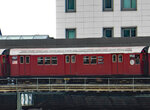
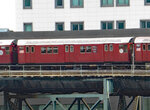
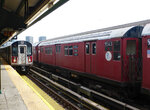
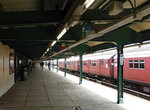
| | Fairly new consist of R44 cars stops at Pleasant Plains (mid
1970s). Photo from the collection of David Pirmann. |
Maps
Track Map (1949, w/North Shore and
South Beach Branches)
Overview
SIRT, now known as MTA Staten Island Railway (SIR) is a
14 Mile, 21 Station, commuter rail line. Geographic north on the main
line is timetable west (vice-versa too). Tottenville-bound trains are
eastbound because Tottenville was the end of the generally west to east
North Shore line that came across the bridge from New Jersey.
The St. George terminal (one of the few remaining
boat-train links in the US), has 12 tracks, 9 that are used for
regular service. Tottenville Station at the southern (western)
terminus has a 3-track yard used for storage. There are shops for
passenger equipment near Clifton Station, and for maintenance and
other vehicles near Tompkinsville Station.
The line was operated as a subsidiary company of the
Baltimore and Ohio Railroad from 1899 until 1971, when passenger
service was taken over by the MTA.
Passenger trains are made up of 64 R-44 type cars,
modified to FRA standards for passenger equipment running on a freight
road. Cars are numbered 388-464, all single units with couplers (no
permanent sets), with 454-464 even numbers only. 388-399 are
transfers from the subway system. Work equipment includes two Alco
locomotives, #844 and #407. An additional locomotive from the subway
system is also on the property. #844 is ex-US Army, 407 is ex-MTA
LIRR. There are some hoppers, flatcars, and a caboose (crew car) used
as maintenance of way equipment.
A recently completed station lengthening project extended
the length of 17 stations, with Atlantic (1 car-length), Nassau (4
car-lenghts) and Richmond Valley (4 car-lengths short). A signal
project has been funded to reverse-signal the line from Hugenot to
St. George; the line currently has the original B&O color
position-light signals.
The operation of the original Staten Island Railroad was
from Cranford Junction, NJ to St. George, Staten Island via the North
Shore line, and then on to Tottenville or South Beach. The passenger
operation on the North Shore (Arlington--St. George) and South Beach
line (St. George--Wentworth Ave) was eliminated in 1953. All of the
bridges over the North Shore line remain, and were recently rebuilt by
NYC DOT.
The South Beach line is abandoned. Several bridges where
the line crossed streets were removed, and one section of the
right-of-way has actually had houses built on it. The Verrazano Bridge
toll plaza destroyed a large part of the right-of-way.
The New Jersey section of the North Shore line, Cranford
Juction-AK bridge was purchased by NJDOT, and CP Rail is looking at
the Howland Hook container port as a NY-area terminal. The City of NY
is looking to purchase the line from AK Bridge to St. George for
resumption of freight service. (Freight service on the island ended in
1990 when the Port Ivory Proctor & Gamble plant shut down in
1990.) A contract was recently let to rehabilitatate the electrical
and control systems of the AK lift bridge across the Arthur Kill, the
longest vertical lift-span bridge in the world. The Howland Hook
container port has been re-opened, and a paper recycling plant has
located at the Travis end of the North Shore line. Additionally, with
the imminent closing of the Fresh Kills landfill, a garbage transfer
station is being proposed for the Port Ivory Proctor & Gamble
plant. All of these industries intend to ship and recieve by rail,
still, the future of rail service on Staten Island is far from
certain.
Station by Station
We begin our ride at St. George, which has
6 island platforms and 12 tracks. Nine of the tracks are active for
service to Tottenville, and two served the abandoned North Shore
line. (Track 10 is the tail leg of a wye, used for non-revenue moves.)
St. George is one of the few remaining ferry, bus, and railroad
terminals in the U.S. and the only one in New York State. At the south
end of the station the tracks enter a tunnel but the north end is open
air (with the ferry terminal above). The railway uses continuous
welded rail and full tie and ballast construction.
In the past, the train fare was paid at St. George on
boarding, and on the train at intermediate stations; with the advent
of the MetroCard, fare is charged only for boarding or alighting at
St. George (payable with Metrocard or bus transfer Metrocard). There
is a token booth that sells New York City Transit MetroCards and is
staffed by SIRTOA employees rather than NYCT employees. The present
system allows for some free rides--you only pay at St. George, as no
other stations have fare control systems. To that end, the
Tompkinsville station seems to have a large number of exiting
passengers in the St. George direction-- presumably to avoid fare
payment.
All stations south of St. George have vapor lighting and
canopies only near exits (which are generally at the south end of the
station). From the southern portal of the St. George tunnel, all the
way to Tottenville, the line has two tracks. White on Black
enamel/metal signs identical to those used in the subway system are
used at all but a handful of stations (Tompkinsville, with no signage;
Stapleton, Richmond Valley, Nassau and Atlantic are black paint
stenciled on white plywood).
The newest station on SIRT, Ball Park,
opened in 2001. This station is west of St. George and
thus not on the "main line" of SIRT. This station is about 150 yards
west of St. George along what used to be the North Shore line. The
station is served by a single track spur from St. George and will
operate on game days to serve the Staten Island Yankees ballpark.
First stop past the St. George tunnel on the "main" line
is Tompkinsville. There are Maintenance of Way and Crew
quarters just past the north end of the station. Passengers are
instructed to exit from the last car, the conductor keying open a
single door at the #2 end of the car. This station is on a concrete
viaduct.
Stapleton is the next stop, an island
platform also situated on a concrete viaduct. South of the station,
yard tracks can be seen entering the line on the St. George-bound
side. This is the connection to the Clifton shops, and where SIR's R44
cars are moved to and from the TA system (by truck).
Clifton is next and is located partly on a
bridge and partly on embankment. An interesting feature is the old
waiting shelter on the St. George-bound side, which is in need of some
TLC. The shelter had four windows, covered up on the southern side,
the west side has evidence of windows existing in the past. The
Tottenville side of the station formerly had an interlocking tower
that controlled the link to the now defunct South Beach line. A close
inspection of the Tottenville-bound platform reveals a stair to the
trackway and former station exit, rendered useless due to platform
extension in the early 1990's. Leaving this station, a look to the
north will reveal the remnants of the South Beach cutoff, and a
dismantled bridge. To the south, a spur on a pair of I-beams on
concrete pillars is the location of an old coal, concrete, and lumber
industry. The line varies from embankment to open cut with the
terrain between here and the next station. Here, the line turns
southward to Tottenville, no longer running along the harborfront.
Grasmere is next. Here there is an
original brick station house from the 1933 grade separation project
over the Tottenville-bound track at the south end. The building is
open only during the AM rush hour. The platform is located in an open
cut and has glass block and concrete windscreens attached to the
canopy supports; the only exit is at the west end of the station. This
is a major transfer point to the S53 bus to Brooklyn, connecting with
the "R" subway at 86th St & 4th Ave. Grasmere crossover, consisting of
two manual switches, is located just past the Fingerboard Rd. overpass
north of the station.
Old Town is next and has a metal canopy
waiting area. The exits at the north end go to Old Town Road; an
additional exit to a short alley is on the Tottenville-bound
platform. Just past the south end of the station, there is a spur that
formerly served the press building of the Staten Island Advance (the
last 'boro daily' in the city) and is now used as a storage spur for
ballast cars.
Dongan Hills is an ADA-accessible station
via overly-long ramps to the street at the east end. There is a
stationhouse on the St. George-bound platform that had a ticket booth
and benches until 1987, and then a token vending machine until July
1997. The station is bounded by Garretson Ave. and Seaview Ave., on
overpasses, and North Railroad Ave. along the Tottenville-bound side.
Leaving Dongan Hills is a section of 3-track line, the
third track (southern) now overgrown. This served a former coal
distributor; grates between the rails led to chutes which now open
into the backyards of homes that abut the embankment.
Jefferson Avenue is next, which has
canopies over the only exit at the north end, to Jefferson Ave. This
is the only station on the line named for the street it crosses. All
other stations are named for the towns that were served. Jefferson
Ave. crossover, two manual switches, is visible from the north end.
This station begins the descent from the embankment to the open cut of
the next few stations.
Grant City marks the beginning of the 1964
grade separation (from Grant City to Bay Terrace, open cut). There are
metal canopies at the south end under the 1964 stationhouse (again,
only benches; the ticket sales ended in 1985 and the token machine was
removed in July 1997). Approximately 150' from the north end there is
a pedestrian crossover. The exits lead to to Lincoln Ave.
New Dorp has two side platforms, the north
abutting the open cut, the southbound against a retaining wall, and is
undergoing its second renovation in the last six years. The 1964
stationhouse is over the tracks at the south end. Exits on the north
end lead to to New Dorp Lane and New Dorp Plaza (North and South
Railroad Aves.) and on the south end to Rose Ave. and New Dorp
Plaza.
Oakwood Heights, the last station to be
grade separated (1965, open cut) has a stationhouse at the north end
and a pedestrian bridge at the south end. This station serves Farrell
High School, and can be a rough place between 2:30 and 3:30 on school
days. North end exits to North and South Railroad Aves. and south to
Guyon Ave.
A nice station which has recently been renovated is next,
Bay Terrace, an island platform located on an
embankment. The exits at both ends are well maintained, especially
the north exit, which has a glass awning and brick sides. Both Bay
Terrace and Jefferson Ave. are notable in that they have historically
served residential areas, not business districts, as the other
stations do. North exit to Bay Terrace, south exit to Justin Ave.
Next up is only other ADA compliant station, Great
Kills. This station has ramps on the north end and metal
canopies over the exits at both ends; the south exit is to the 1933
stationhouse and Giffords Lane (original station name was 'Giffords');
north exit is ADA ramps and a pedestrian bridge to Giffords Glen. The
station is located in an open cut, and is the only station other than
Tottenville and St. George where trains are regularly terminated. New
crossovers were installed in 1997 north of the station. The remains
of a spur are visible at the south end.
Eltingville is next with two side platforms
on an embankment. Exits are at both ends of the northbound platform,
but only at the south end of the southbound platform. The north exit
leads to Eltingville Blvd, and the south exit to Richmond Ave., a
major transfer point to the X1,4,5,6,9 buses to Manhattan, and the S59
and S79 buses to the Staten Island Mall, Hylan Blvd., and 86th
St. Brooklyn. The canopy at the ends is concrete. The stationhouse
here is on the street level at the Richmond Ave. exit, and at one time
featured a signal lamp that alerted those waiting that a train was
arriving. On the exterior of this stationhouse is a plaque noting the
Great Kills to Huguenot grade separation project was done under the
auspices of the Works Progress Administration.
Annadale is next, and has stationhouse,
built in 1939, at the south end. A footbridge over the north end of
the station provides an exit to North Railroad St. and a park and ride
lot on the northwest corner. There are steel/concrete canopies over
both the south (Annadale Rd.) and north exits.
The next station, Huguenot, is practically
a mirror images of Annadale, this time with the stationhouse at the
north end. A steel and concrete canopy is over the platforms at the
north end exit (Huguenot Ave.), and an additional canopy is located
about halfway down the southbound platform; however, there is no
footbridge or parking here. Some AM peak express trains originate
here, a set of crossovers are provided for this service north of the
station. A spur used for ballast trains is off the northbound track
across Huguenot Ave. from the station entrance.
Prince's Bay (alternately known as Princess
Bay and Princes Bay) is next and suffers from a name problem--the maps
show the name without the apostrophe while station signs show the
apostrophe. The historically correct (and official) name is on the
station signs. There are two side platforms with a concrete canopy and
exit to Seguine Ave. on the north end, and a steel/concrete canopy
near the south end of the southbound platform. This station was the
last all-timber platform on the line (and perhaps the city), and was
replaced in the early 1990's.
Pleasant Plains is next, with
steel/concrete canopies and exit down at the south end to Amboy Rd.
North of the station is another set of crossovers, and the
right-of-way of a spur that formerly served Mount Loretto. The B&O
served the Mt. Loretto non-electrified branch until 1950, which had
some industry and a passenger station. The track was removed in the
60s and 70s with some ties were visible until the 80s. A coal dump
trestle (shown in the photos) is all that remains, located behind the
powerhouse.
Next up is Richmond Valley, a flag stop
nestled between Page Ave. and Richmond Valley Rd. Exit from the
Tottenville platform and end of the two wall platforms is up while the
St. George platform exit is down. This station is in need of
renovation. A grade crossing at Richmond Valley road was removed in
1940. The Tottenville-bound track has a non-electrified spur that once
ran all the way to the Arthur Kill. The spur was built in the mid
1920s and dubbed by the B&O as the West Shore Line. The B&O delivered
building materials to the Outerbridge Crossing construction site near
the Kill. There was also a small industry on the spur known as
Roselli Bros. The track remains intact today all the way to Page Ave.
The switch at the spur is well kept and working.
Note in the image taken from Page Ave., that the spur
still extends quite far from the station, and the creek that runs
parallel to the track. Very bucolic indeed! A St. George bound SIR
train is visible in the background.
Nassau is next. An interesting feature is
the old faded black on white wooden signs. There is a crossover and
exit up at the south end. Behind this station is the the Lucent
Technologies metal recovery center (formerly AT&T/Bell Smelting), and
another spur, disconnected from the line, is behind the northbound
platform.
Atlantic, another flag stop, is next. There
is a crossover between the two side platforms, and the exit is down
stairs to street level. The platforms here are only long enough for a
single R44 car, and the conductor opens a single door manually at this
station for those few people wishing to enter or exit the train.
We arrive at Tottenville and are treated to
a view of the water to the east and south of the station. A crew room
is located in the old stationhouse/tower at this station. The old
slip for the ferry to Perth Amboy still stands nearby at the end of
Bentley St. On a clear day, if you look hard, you can see the
restored Perth Amboy slip on the New Jersey side of the Arthur Kill.
There are three yard tracks on the east side of the center platform.
Minor renovation is underway and exit is via a ramp at the southeast
end (Main St.) and a pedestrian walkway and bridge allow exit at the
north end. This is the southernmost rail station in New York
State.
|