
The 3rd Avenue Elevated
Overview
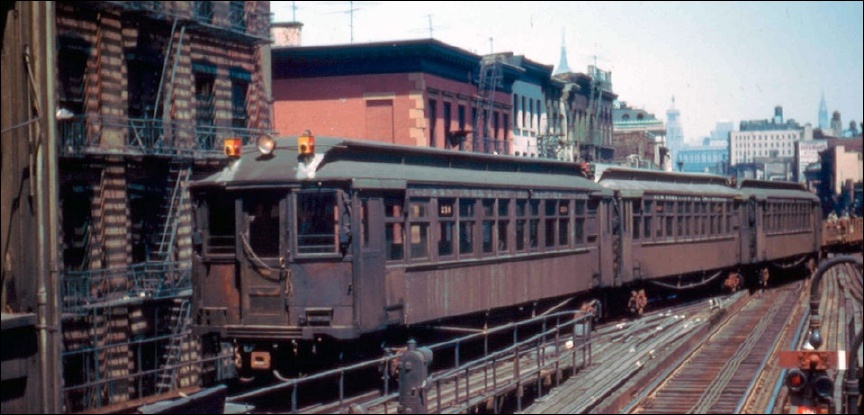
The 3rd Avenue Elevated line in Manhattan was constructed between 1875 and 1878 by the New York Elevated Railway Company. The line was to run from City Hall along the Bowery and Third Avenue to the Harlem River. The Manhattan Railway Company took control of the New York Elevated Railroad in 1879, and in in 1891, the Manhattan Railway took over operations of a short railroad between 129th Street and 133rd Street in the southern Bronx, then operated by the Suburban Rapid Transit Company. Through service between the Bronx and Manhattan began in 1896. A 999-year lease deal made in 1902 brought the Third Avenue El under the control of the Interborough Rapid Transit Company.
Later construction under the Dual Contracts triple-tracked the main line of the elevated railroad in Manhattan and the Bronx. Originally operated by wooden elevated "gate" cars, these cars were later modified with closed-in vestibules and automatic doors and were known as the "MUDC" (Multiple Unit Door Control) fleet. In later years the 3rd Avenue line was operated by IRT "Composite" cars, retiring the MUDC fleet. Finally, after the 1940 transit unification, the 3rd Avenue el even saw BMT "Q" type cars running in Manhattan and the Bronx.
The Third Avenue El was the last elevated line to operate in Manhattan. Service to South Ferry ended in 1950, and to City Hall in 1953. The main line of the 3rd Avenue elevated in Manhattan had service from Chatham Square north until 1955. From 1955 to 1973 Bronx service operated between 149th St and Gun Hill Road.
Track Maps


The New York World, August 27, 1878
The New York World · Tuesday, August 27th, 1878. East Side Rapid Transit; Trains clattering over the elevated iron road up the Bowery and Third Avenue.
The east side branch of the New York Elevated Railroad fulfilled part of the promise of rapid transit yesterday by beginning to run trains from the South Ferry to the Grand Central Depot in Forty-second street. All matters had been thoroughly arranged before the first trip was made; the exact running time that the new engines could make was decided upon and a schedule had been carefully arranged. There were but few stations, however, at which passengers were picked up and dropped. Those were at South Ferry, Hanover square, Fulton street, Eighth street and Forty-second street. The first trip was made from South Ferry to Grand Central Depot at 5:30 A. M., and the distance traveled in twenty-five minutes.
A reporter of THE WORLD road on a train that left South Ferry about 1 P.M. This station is a common one for both branches, and many crowd in waiting started for the door when the agent called out "All passengers for the east side or Third avenue." There were two handsome cars on the train of maroon color, touched with gold and light paints, and glistening with varnish. The engine also was new and was provided with a regular locomotive cab. The cars within were finished entirely in wood, the seats being of perforated pattern now so common, and running lengthwise of the car. The roofs were slightly decorated, and there was an appearance of neatness without the attempt at elegance of the Metropolitan road.
While the reporter was examining the cars with a critical eye the train was already far on its way through the narrow down-town streets. Through Pearl street it ran, making a deafening clatter with the rattle of the road itself, the grinding of the wheels and the reverberations from the buildings. People in the street below, however, seemed to pay no attention to the engine and cars and the horses stood quietly in front of their trucks and carts, without drivers near, and munched their fodder. In Third avenue the horses of the surface cars and of wagons jogged along, people looked into shop windows and not to the sky, and the only difference was the train, having more room on each side, did not make so much noise.
By this time, after one or two stops, the two cars were comfortably filled, several of the passengers being women. The reporter, for lack of anything else to do, attempted to read the store signs, as he was rapidly carried along. Only the big ones were readable. A woman knitting at a window was unpleasantly confounded with a man pressing hats, and a barber in the second story of a house, leisurely shaving a customer, became by a sort of dissolving view arrangement a fat German woman energetically spanking a child.
Cooper Institute suddenly loomed up -- a dark mass. There was not much of the journey left after this, nor much novelty. There was the same round of women sitting at windows, sewing and occasionally half lazily looking at the cars that shot past their houses; and of people quietly walking along the streets, until the train turned to Forty-second street, frightened a team of horses attached to a brewer's dray and then halted at the Grand Central Depot.
As the reporter passed out of the car he said to one of the conductors:
"Were you connected with the west-side road?"
"Yes," answered the man.
"Have you noticed any difference between the noise of the two roads?"
"I should think I have."
"Which is the worst?"
"This."
It is certain that a horrible shriek and squeak of metal on metal, as if the cars were dragged over the track with brakes down, is sometimes to be heard on the east side and strange to the west.
The construction of the east side branch of the New York Elevated road was begun about the 1st of last November, under contracts with the New Jersey Iron and Steel Company, the Passaic Rolling Mill Company. J. B. & J. N. Cornell and A. R. Whitney Brother, the railroad company furnishing the plans and specifications. There are two different kinds of structure on the new road. The longitudinal girders and columns are substantially the same on both branches, but on Front and Pearl streets, as far as Franklin square, the columns are straight up to the cross girders. The remainder are curved. On Third avenue, above Fifth street, the two tracks are connected by arched girders. Mr. Walter Katte, the chief engineer of the road, said yesterday that he thought the road would be finished to Sixty-first street about October 1st and to Harlem before the 1st of January.
Each car will accommodate forty-eight persons.
The engines are all of the same kind, excepting that some have four wheels and others eight. Both will be tried until it is found which will answer best. Many new men have been taken on and the entire force has been divided between the two branches, so that there will be an old hand on each train running on the east side. The trains will run at ten-minute intervals between 5:30 and 6: A.M., five minutes between 6 and 10 A. M., six minutes between 10 A. M. and 3 P. M., five minutes between 3 and 7:30 P. M., and ten minutes between 7:30 and 8 P. M., when the line will be closed. Between the hours of 5 and 7:30 A. M. and 5 and 7 P. M. the fare will be 5 cents; at other times, 10 cents. The running time for the trip will be twenty-five minutes until the engines and cars are broken in.
The following answers about the noise on the road were collected by the Post reporter:
At Lamke Brothers', grocers, No. 103 Third avenue: "Naw, we are used to noises on this avenue."
At Charles Eitenbenz's boot and shoe shop, No. 89 Third avenue: "No, in about a week we don't hear it no more."
At Meyerholz & Blum's florists, No. 77 Third avenue: "No, we ain't got no time to notice it."
At George P. Lies's cigar store, No. 59 Third avenue: "No, it doesn't make as much noise as Sixth avenue."
At George W. Hamill's, undertaker, No. 26 Third avenue: "No, you listen now: it's not as loud as that street-car."
Photo Gallery
| Five Random Images | ||||
 Image 6791 (348k, 1024x683) Collection of: David Pirmann Location: 59th Street |  Image 28663 (105k, 732x1024) Photo by: Jack E. Boucher Collection of: Library of Congress, Prints and Photographs Division Location: 166th Street |  Image 43164 (61k, 800x545) Collection of: Christopher Sattler Location: Fordham Road |  Image 57176 (148k, 820x553) Photo by: Kenneth Palter Collection of: Bill Palter Location: 161st Street |  Image 57350 (87k, 553x820) Photo by: Bill Palter Location: Gun Hill Road |
Photos By Location
Photo locations: South Ferry, Coenties Slip Curve, Hanover Square, Fulton Street, Franklin Square, City Hall, Chatham Square, Canal Street, Along the Bowery, Grand Street, Houston Street, Cooper Square, 9th Street, 14th Street, 18th Street, 23rd Street, 28th Street, 34th Street, 34th Street Spur - 3rd Avenue Lower Level, 34th Street Spur - Substation, 34th Street Spur - 2nd Avenue Lower Level, 34th Street Spur - East River, 42nd Street, Grand Central (Branch), 47th Street, 53rd Street, 59th Street, 67th Street, 76th Street, 84th Street, 86th Street, 89th Street, 99th St. Yard, 99th Street, 106th Street, 116th Street, 125th Street, 129th Street, Harlem River Bridge, 132nd & Alexander, 133rd St. Yard, 133rd Street, Willis Ave., 138th Street, 143rd Street, Bergen St. Cutoff, 149th Street, 156th Street, 161st Street, 166th Street, 169th Street, Claremont Parkway, 174th Street, Tremont Avenue, 180th Street, 183rd Street, Fordham Road, Bronx Park, 200th Street, Mosholu Parkway Overpass, 204th Street, 207th St., 210th Street, Gun Hill Road