
A Historic Perspective of the R-26, R-28, and R-29
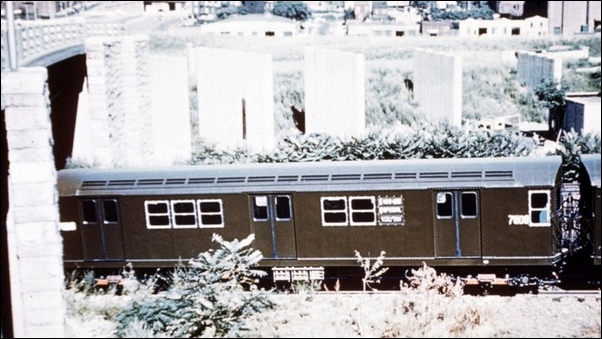
R-26 cars being delivered to NYCTA using the NYW&B connection from the New Haven Line to East 180th Street, August 3, 1959. Photo collection of David Pirmann.
A Historic Perspective of the R-26s and R-28s
By George Chiasson, Jr.
A narrative detailing the lifetime history of R-26s and R-28s (as well as the R-29s) should be available at a future date, but for the moment the conclusion of their 43 years of passenger service deserves special recognition. Ordered in tandem with the BMT's R-27s, R-30s and R-30As under the administration of NYCTA Chairman Charles F. ("Choo-Choo Charlie") Patterson, the R-26s and R-28s were acquired from ACF to continue the process of replacing first-generation IRT rolling stock. Specifically, they supplanted the so-called "Flivver" Lo-Vs which had been used to permit transfer of Composite cars to the Manhattan Elevated lines in 1916. Control componentry was divided between Westinghouse and General Electric manufacture across the combined 210-car order, with the WH R-26s (7804-7859) first to arrive through the last quarter of 1959 and into early 1960. The remaining three groups (GE R-26s 7750-7803, WH R-28s 7860-7909 and GE R-28s 7910-7959) were on the property by 1961, and all assigned to Westchester Barn for use on the #6. They were denoted by their monotonous dark olive green color during those early years, which clashed with the line's maroon R-17s, then eventually its red R-29s and R-33s after 1963 as all were intermixed in train consists.
In February 1966 all IRT equipment was assigned to specific maintenance facilities, and therefore certain routes, based on electrical equipment. From this time forward for a number of years, the GE R-26/28s were found on the #2, #4 and #5 lines mixed in trains with virtually any type of IRT "SMEE" equipment, from the oldest R-12s to the relatively new Mainline R-33s. Meanwhile, the WH portion remained at Westchester, sharing duties with like-equipped R-17s, R-29s and R-33s. As cars began to change color from maroon, red and green to silver and blue (and besmirched by graffiti), assignments were consolidated further in October 1976 and the GE R-26/28s earned their keep on the #2 and #5 lines, then based at Livonia, East 180th and 239 Sts. Equipment for the #2 and #5 was separated in January 1983, and as though to herald their ultimate destiny, the GE R-26/28s were blended with the GE R-29 group in #2 service, along with GE R-14s, R-15s and R-22s. An early, ill-fated attempt to combat municipal vandalism saw cars on the #2 and #6 lines redone in several coatings of white paint during 1982-83, and over the following four years the older, single-unit post war IRT fleets were gradually weeded out as R-62 and R-62A cars arrived to replace them.
Through the General Overhaul (GOH) program prescribed and engineered by the NYCTA, M-K was able to extend the life of moderately aged SMEE cars during the 1980s. This transformed them from aging, disfigured and operationally untrustworthy subway cars to an upgraded, highly reliable and graffiti-free fleet within a period of several months. The first GE R-26/28s were shipped to Morrison-Knudsen's rebuilding facility in Hornell, NY, straight from 239 Street, in late 1985. The first 10 car train of GOH R-26s was placed in #2 service on January 13, 1986, followed by the first pair of GOH R-28s in February. Both types immediately began mixing in consists with GE R-29s that were also going through GOH, and the famous "Redbirds" that have become so familiar on the IRT lines came into being.
By July 1986, all 104 of the original GE R-26/28's had been removed from the #2 and were going through the rebuild process. Meanwhile R-26/28s of the WH variety remained in #6 service until they, too began moving to Hornell in March 1986. The last such pair, still in more or less original configuration (except for air-conditioning and changes in flooring and paint scheme) was 7908/7909, which departed the #6 line in April 1987. Cars 7842/7843 were the last pair of GOH R-26s to enter #2 service on March 19, 1987, while the final four R-28s (7908/7909 and 7930/7931) didn't start carrying #2 passengers until October 22.
As delivered from M-K, the R-26/28s retained their original "semi-permanent" configuration and were often not numerically paired. This was especially the case among ex-#2, ex-GE groups (7750-7803 and 7910-7959) and reflected an almost constant process of pre-GOH intermixing to optimize reliability and minimize long intervals in the shop. Among many significant changes made as part of the GOH process, the entire 210-car R-26/28 fleet received a relatively up-to-date General Electric SCM control system. As built, the GE cars had contained an archaic MCM control package that was considered finicky by many, while replacement of the WH cam control group on the ex-Pelham cars enabled the standardization of parts stocks, inspections and repair procedures. By 1991 this and completion of the Mainline R-33 GOH process paved the way for implementation of the Scheduled Maintenance System (SMS). As a result, all R-26/28s were mated numerically and permanently linked at the B-ends by a drawbar.
All 210 GOH R-26/28s provided many faithful years of service to the #2, being swapped to the #5 in exchange for most of the GOH Main Line R-33 fleet in 1995. The R-26/28s were fortunate in this regard as the entire fleet had been spared the misfortune of early retirements due to collisions or fires. After R-142s began service on the #2 in mid-2000, Redbird R-33s were displaced concurrently from the #2 to the #5, and the first eight R-26/28/29s withdrawn in late May of 2001. Despite their decreasing number and advancing physical deterioration, the cars continued to provide reliable service to NYCT customers, weekends included, for another year. Then, as the second wave of R-142s were placed quickly and directly into service on the 5, the presence of Redbirds diminished accordingly. By the late summer of 2002, the final train or two of R-26/28/29s was making consistent appearances on the #5 each rush hour, their longevity linked to the halting progress of R-142 deliveries. As the new cars ultimately overcame their many technical and operational hurdles, time was clearly no longer an ally and the end came at last on October 7. Their final retirement continues to close the book on operational technologies which have evolved over many years and served the New York Subway system well. Moreover, it ends the legacy of builder American Car & Foundry, which has been represented locally since inauguration of the IRT Subway in 1904.

Shiny new R-29 cars at Concourse Yard, April 1962. Photo collection of David Pirmann.
A Historic Perspective of the R-29s
By George Chiasson, Jr.
As part of an overall campaign to concentrate resources on the renewal of existing NYCTA assets, as opposed to expansion of the system, Chairman Patterson underscored the urgency of replacement rolling stock in 1959 by threatening to cut service if necessary to keep deteriorated cars from becoming a safety hazard. Most on the system were 20 years of age or older, many of those 35 years old or more. Though a small start had been made in the post-World War II era through acquisitions of the R-10 through R-22 series (1948-1957), with 210 more R-26/28 cars in the pipeline for the IRT, many of these newer SMEEs were being used to expand train lengths on existing lines and increase service levels where possible. Despite these measures the huge fleet of aging pre-war cars remained the backbone of the NYCTA system, and to stave off later negative effects on service availability, action had to be taken and soon. In 1961, the Authority sought financial participation from the State of New York for the broad-based acquisition of 1,800 subway cars. 1,200 of these would be assigned to the IRT to replace all remaining pre-war equipment, including that used on the Third Ave. Elevated line in The Bronx. The balance would be used to renew the BMT service fleet and provide additional equipment for service additions associated with the Chrystie St. Connection, then being built.
Ultimately, this proposal was left on the table as the State Assembly in Albany adjourned for the year, and NYCTA proceeded on its own, using bonds to accumulate capital funds. 236 IRT cars ordered from St. Louis Car Co. under Contract R-29 was the first in a series of acquisitions spawned by this arrangement. The specifications drawn up were very similar to the R-26/28s then being delivered, with slight changes in undercar materials and flooring to shed a little weight. These were also the first permanently arranged "married" pairs on the system, joined at the B-ends by a drawbar (also called a linkbar) which required separation by the shop. Aside from a handful of different supply vendors, GE cars 8688-8805 offered a modicum of technological advancements including high-voltage circuit breakers instead of fuses on the main electrical panel and the first use of an up-to-date SCM control group. By contrast, 8570-8687 used a standard Westinghouse Cam Control system, as introduced on R-22s 7505-7524 in 1958. In response to interest expressed by the Chairman in improving New York's generally anachronistic technical specifications (and ironically at the time of his death), WH cars 8686/8687 and GEs 8804/8805 were fitted onto General Steel Castings (GSC) #70 trucks, which had evolved from PCC rapid transit designs through the years. In time these, or a modified version of them, were commonly applied to rapid transit cars built for Cleveland, Boston, Toronto and in direct comparison to NYCTA, the Hudson & Manhattan. General #70s included a built-in or "Package" tread brake unit which gripped the inner edge of each wheel, while the NYCTA's standard cast steel frame "Equalizer Bar" trucks had "clasp" braking which gripped the outer surface.

R-29 8686-8687 in service on the #6 at Whitlock Avenue; notice the different trucks. August 1963. Photo collection of David Pirmann.
The first R-29s arrived in New York on March 28, 1962 by barge, being greeted on their way up the East River by a spray-over from an FDNY Fire Boat and foghorn calls from passing marine vessels. After initial testing 8570-8579 were operated as a "Special" 10-car train on April 29, roaming the #7-Flushing line, which at that time was using teen-aged R-12/14s and R-15s with replacement cars anticipated. Formal revenue service commenced the following day on the #1 line, the R-29s running separate from the usual dreary consists of R-17/21/22s, and making a sensational visual splash. Instead of maroon or olive drab, they were colored in bright tartar red paint (bearing the City of New York seal) with purplish-blue interiors. The Westinghouse half of the order arrived first followed by the GEs, with the four experimentals coming in last. Through the summer of 1962 the R-29s gradually supplanted all R-17/21/22s on the #1. In turn these filled the ranks on the #2 and #3 lines, so the surviving Lo-Vs could be concentrated on the East Side Express routes. This led to withdrawal of the last 1916-vintage "Flivver" cars from the Lexington-White Plains Rd. line (today's #5) in August. In those days, IRT equipment assignments were a great deal more mixed than they are presently, with groups being shared across several different routes. All #1 consists were then 8-car trains because platform extensions were still far from complete. As part of their use on the #2 and #3, R-29s were sometimes found on the #5 at night and on weekends as well.
In September 1962, mixed R-17/21/22/29 trains were the first blends of SMEE cars regularly assigned to the #4-Lexington/Jerome Express. Some R-21/22s returned to the #1 (now mixed with R-29s) and trains of Lo-Vs were back on the 7th Avenue Express routes. This freed up R-17s for movement to the #6, where consists were extended from 8 to 9 cars. Additional R-17s were also shifted to Flushing by November to expedite 11-car operation. R-29s continued to dominate the #1 until March 1963, when R-12s, R-14s and R-15s began coming over from the Flushing Line in preparation for the extension of consists to 10 cars. At that time approximately 50 R-29s wound up on the #6 line where they were joined by a large group of newly-delivered Mainline R-33s. For the next two years all other R-29s melted into one giant pool of rolling stock which was spread around IRT lines #1, #2, #3, #4 and #5. Main Line R-33s were assigned to specific routes by May 1965 to provide communication with at least one set in each train, and the R-29s departed the #6, all 236 then to be found on the #2, #4 and #5 tines. Beginning in 1964, the R-29s original red color led to a partial repainting of the older R-12/14/15/17 fleet into a similar scheme. With distribution of the IRT fleet based on electrical equipment in February 1966, the 118 WH R-29s were used on the joint #1 and #3 lines, while the GEs went to the #2, #4 and #5. WH R-12s 5707-5729, which were sent to Work Service at that time, were restored to revenue service on the #1/#3 a year later and R-29s 8570-8599 correspondingly transferred to the #6, where the Pelham fleet amounted to an incredible (by today's standards) 549 cars! Experimental cars 8686/8687 and 8804/8805 (so-called for their lack of outboard journals, which exposed the wheels and axles and looked like oversize "roller skates") were in service with conventional heavyweight trucks by early 1970. From there the story becomes somewhat predictable, as the R-29s relative modernity shielded them from the 20% fleet cut of October 1976, but they were removed from the #4 as joint assignment with the #2/#5 was discontinued. Starting in the early 1970s, increasing numbers of R-29s were repainted into the standard MTA blue and silver scheme, as the graffiti "work" of vandals also gained momentum.


The "graffiti control" all-white paint scheme. The white paint was not as graffiti resistant as the MTA had hoped. Prolific graffiti painter "SEEN" has tagged the train in the bottom photo in October, 1982. Top photo, Doug Grotjahn, bottom photo, Steve Zabel, collection of Joe Testagrose.
As the GE Worlds Fair cars headed to Morrison-Knudsen at Boise, Idaho for contract rebuilding, GE R-29s 8734/8735 and 8804/8805 were among an array of standard SMEEs loaned to the Flushing line from September to November 1983. Air conditioning was retroactively installed on most of the R-29 fleet in the early 1980s, but after assignments were again broken up in January 1983, WH cars assigned to the #1 (8600-8687) were among the last to receive it in 1984. This process also included the interiors being repainted from institutional green and gray into brighter beige and orange tones. WH R-29s on the #6 (8570-8599) were repainted into the unusual all-white paint scheme between late 1982 and approximately April of 1983. All 118 GE R-29s were concentrated on the #2 after January 10, 1983, mixed with GE R-14s, R-15s, R-22s, R-26s and R-28s. They, too received the "whitewash" coloring through the following Spring, followed by the 8600s on the #1 between July and December. By mid-1984 cars 8640-8649 were being kept in a relatively clean, solid consist and emblazoned with "Spirit of Broadway" on the car sides in orange script. Later that year, an accident created oddball mis-mate 8672/9135, a half R-29/half R-33 pair that was observed on the #6 between December and February, then on the #1 through the end of 1985. As R-62s entered service in 1984, followed by the R-62As in 1985, cars were shifted around the system to replace the oldest SMEEs, which were by that time almost totally concentrated on the #3. In April 1985 this maneuvering resulted in the transfer of WH R-29s 8600-8619 from their Broadway base to Brooklyn's Livonia barn for use on the #3. There they replaced the Mainline R-36s, which had been shifted to the #7 en route to GOH.
10 GE R-29s were the first cars shipped to Morrison-Knudsen's plant in Hornell, New York during June 1985, after the NYCTA let an initial contract for the complete General Overhaul (GOH) of all 446 R-26/28/29s. These returned to the property for evaluation and testing in September, and by the i time the first train of true "Redbirds" was placed in revenue service on the #2 on October 21, there were 28 cars already back from Hornell. The cycle of white GE R-29s going out to M-K and being replaced almost in kind by Redbird R-29s returning was the story through the end of January, 1986, by which time there was only one unrebuilt train left in service. This was comprised of cars 8722/8723, 8746-8749, 8752/8753 and 8788/8789, and was largely in as-delivered configuration, but for cosmetic changes like paint and flooring, as well as air-conditioning retrofits. GOH GE R-29s began mixing in trains with GOH R-26/28s on January 13, and never broke that pattern through the end of their service days. All were rebuilt and back on the IRT as of June 10, 1986 but for one mis-mated pair (8702/8723, which did not return until the entire effort was completed).
R-29s 8660/8661 were the first Westinghouse pair to go north, along with the final shipment of GEs in February 1986. This set was unique in that it was rebuilt with a modified prototype interior mimicking the R-62/62A class, featuring fixed stanchions in place of traditional spring-loaded Ellcon handstraps. As the WH R-29s were intended for service assignment to Westchester Barn, a Westinghouse-oriented facility which provides cars for line #6, they were equipped with an upgraded version of the WH Cam control package they had been built with. The first cars from the 8600-8619 #3 group went to Hornell to form the WH R-29 pilot train in March, then as new R-62As entered service on the #1 through April and early May of 1986, about half of its WH R-29s were shifted to the #6 line, from which they were eventually forwarded to Hornell. By the end of May the first cars of the 8570-8599 #6 group were at M-K, and the entire 8600-8619 sub-group had departed the #3. These were temporarily replaced by other higher-numbered 8600-series WH R-29s from the #6. With continuing arrival of the R-62As, all WH R-29s (what was left of the 8620-8687 sub-group) were removed from the #1 as of June 2, 1986.
Meanwhile, 8660/8661 had returned to New York and were accepted for revenue service on May 14. As there were as yet no Redbirds (or any improved equipment) on the #6, they were blended in with the GE R-26/28/29s and resumed their career on the #2. This would be the case for subsequent WH GOH cars for a few months to come, until such time as R-62As were allocated to Westchester and the Car Appearance Program (CAP) set up to ward off defacement through graffiti. During June 1986 the first 8600's (former #1 cars) went straight from the #6 line to Hornell for GOH. Through the unusual transfer of 18 GE R-33s, all of #3's remaining WH R-29s (8624/8625, 8664/8665, 8670/8671 and 8682/8683) were reallocated to the #6 on June 25, and the class disappeared from the West Side IRT.
By the end of that month there were 10 WH R-29 Redbirds on the #2 line, just enough to make up one whole train. New cars continued to be broken in on that route, but on July 10, 1986 the first 18 "experienced" GOH WH R-29s began running on the #6 line, just a few weeks after the first R-62As heralded the start of graffiti eradication on that route. By August 16 there were again 18 GOH WH R-29s, fresh from Hornell, mixed into the #2 fleet. A week later cars 8640/8641 became the first pair to be accepted at Westchester and resume service straight onto the #6. This completed the shift of program focus and as of September 9, all GOH WH R-29s that were left on the #2 (8634/8635, 8652/8653, 8656/8657, 8668/8669, 8676/8677) were finally redirected to Westchester. 8570/8571, two of the original cars from the 1962 Flushing demonstration, and 8598/8599 became the very last non-GOH, non-CAP WH R-29s to be removed from passenger service on the #6 in early December 1986. Non-CAP WE R-17s, R-22s, R-26s, R-28s and R-33s remained for a time until all were gradually retired or sent to M-K by the end of 1987. At the end of January 1987 there were 90 cars (nine trains) of GOH WH R-29s in use on the #6, then 114 by the end of March. The 118-car group was completed with the acceptance of 8598/8599 and 8570/8571 on May 5 and 6, respectively. The last two pair of GE's were confounded by unexpected problems, so as an interim measure 8703/8722 was returned as a mis-mate in May of 1986, but not followed by 8702/8723 until October 22, 1987, at which time the 446-car contract was closed out. Shortly afterward, both sets were reunited with their natural mates.
The GOH R-29s then led a prosperous service life for many years. No assignment changes occurred at all until May 1995, when all R-26/28/29s were swapped from the #2 to the #5 in exchange for GOH R-33s. This in part was intended to stem the run-up in mileage owing to the all-out, 24/7/365 operating nature of the line known to many as "The Beast." With its nominal part-time status, the amount of abuse the older Redbirds was subjected to on the #5 was lessened, which helped to extend their reliable, useful life into the 40-45 year range.
In July 2000 the first trains of R-142 and R-142A New Technology trains were placed in operation on the #2 and #6 lines respectively. These had been procured specifically to enable retirement of the physically aging and deteriorating Redbirds, so to ensure removal of the oldest cars first, R-142s assigned to the #2 were used to gradually bump GOH R-33s over to the #5, from which R-26/28/29s could be removed and disposed of. The new R-142As entering service on the #6 would serve to replace the Redbird fleet there directly. Problems with the new cars persisted, and the retirement process delayed until May 2001, by which time four GEs and the first 10-car train of WH R-29s were already in storage. With direct replacement by the more reliable R-142As, withdrawal of the WH cars proceeded at a much faster, steadier pace and by the end of November 2001 only 46 cars (4 trains) were left. These were further reduced to one just before Christmas and on December 26 the last of them which used cars 8588/8589, 8632/8633, 8640/8641, 8656/8657 and 8682/8683 operated in passenger service. 8652/8653 closed out the tenure of WH R-29s on MTA NYC Subway by being the last pair to depart Westchester Yard on December 31, 2001. The class in general was reefed by late March of 2002.
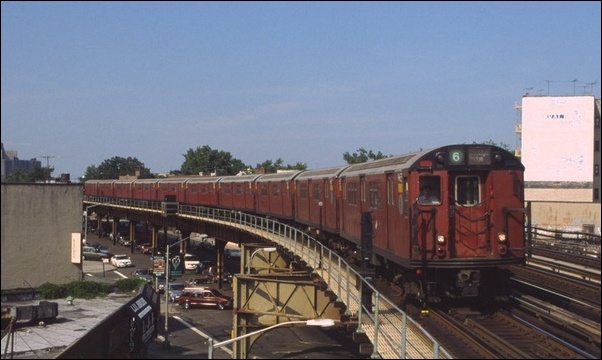
Redbird R-29 8653 on the point of a southbound #6 service entering Buhre Avenue in July 2001; 8652/8653 were the last pair of R-29 cars scrapped in December 2001. Photo by Chao-Hwa Chen.
Because there was a larger overall fleet to retire, continued troubles with the R-142s and the task was being accomplished in a third-hand manner, withdrawal of the GE R-29s followed a leisurely pace through the balance of 2001. The first large group of retirements finally occurred in December, with 56 remaining as the New Year dawned. From this point through the end of May 2002 there was about one train per month removed from service on the #5, as they were replaced by R-33s imported off the #2. There were 24 GE R-29s remaining when R-142s were directly assigned full-time to the #5 in May, and use of the few R-26/28/29 trains still active plummeted accordingly. By the end of August there were just 14 still in service during rush hours, enough to create two trains when mixed with the handful of R-26/28s that were still in operation. These made their last trip on October 7, after which a lone consist of GE R-29s continued to see duty on the #5 on a day-to-day basis. Finally, the curtain call came at the end of service on Thursday, October 24 and after just over 40 years of service the R-29s departed the big city stage they had served so well.